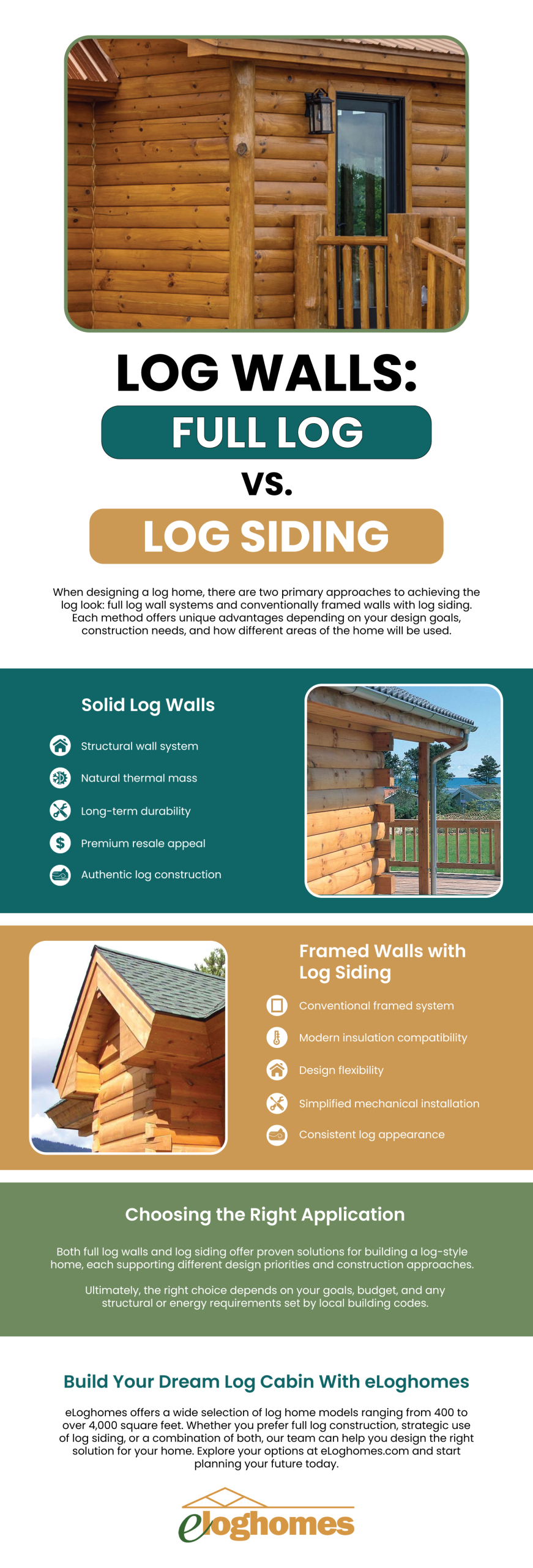
When planning a log home, you have options for how to achieve the look and feel of solid log construction. Both full log walls and log cabin siding offer distinct advantages depending on your design goals, budget, and how different areas of the home will function.
You’ll often see log siding on the upper levels of a home and on dormers, gable ends, garages, and walk-out basements. These are areas where solid log construction may not be required, or where conventional framing provides flexibility. In some designs, homeowners choose log siding for specific areas of the home where structural full log construction is not required.
Key strengths of log siding include:
- Lower construction costs: Framing with conventional lumber and applying log siding on some parts of the home may cost less than full log construction.
- Design flexibility: Siding is ideal for second floors, gable ends, garages, or any area where full logs aren’t practical or needed.
- Consistent appearance: Log siding is typically crafted to match the look of full-size logs to maintain a cohesive look and curb appeal.
Log cabin siding is applied over conventional framing, which can simplify plumbing, electrical, and HVAC installation in certain designs. This approach offers flexibility for specific architectural layouts and design preferences.
eLoghomes produces log cabin siding from the same Eastern White Pine materials used for our full logs. We offer multiple heights to match the exterior profile and corners of first-floor log walls for a seamless transition.
Full log walls provide natural thermal mass and structural strength, while conventional framing systems with log siding rely on modern insulation methods to achieve energy performance.
Both full log construction and log siding play important roles in log home design, depending on your priorities and how each space will be used. Scroll down for a side-by-side comparison to help you choose the right solution for your dream log home.